

Every shop has two stocks. One is on the shelves. The other is in the book, or the till, or the spreadsheet: the number the system thinks you have. A stocktake is how you find out how far apart they are, and why.
In a small shop it does not need a weekend or a team. It needs a plan, a pen or a phone, and one rule that most people break: count first, look at the book after.
This guide is for anyone who sells things from a counter, a shelf or a stall. The words differ by country, and so does the paperwork. The method does not.
What is it called where you are?
| Where | Usual words |
|---|---|
| UK, Ireland, Australia, New Zealand, South Africa | stocktake, stock take, stock count |
| US, Canada | inventory count, physical inventory |
| Everywhere | cycle count (counting a part of the shop on a rota, not all at once) |
Whichever you say, it means the same thing: count what is physically there and compare it with what your records say.
Why bother
Four reasons, in the order a small shop usually feels them.
- You find out what has gone missing. Waste that was never written off, a case that was short on delivery, a price that was rung up on the wrong item. Theft is one possible cause among several.
- You stop ordering by guesswork. When the book says 12 and the shelf has 2, every reorder you made from the book was wrong.
- You know what your stock is worth. Stock at cost is what your accountant or your tax return will ask for at the end of the year. The rules are different in every country, so check yours with your accountant or your tax authority. Some places let very small businesses use a lighter method; do not assume yours does.
- You can trust the numbers again. A book that has been checked and corrected is a tool. A book nobody has checked is a rumour.
Before you count
Pick a quiet time. First thing before opening, or after closing, or a slow afternoon. A count done with customers in the way has mistakes in it.
Stop the stock moving, or write down what moves. Do not receive a delivery in the middle of a count. If you must sell while you count, keep the till going but keep a list of what you sold from the area you have already counted, so you can add it back.
Split the shop into zones. A shelf, a fridge, a stock room, a stall table. Name each one and give it a number. Count one zone at a time, finish it, and move on. The reason for zones is simple: when a number is wrong, you know which few metres to search.
Tidy as you go. Face the labels forwards, put strays back where they belong, and set aside anything damaged or out of date. Do not count what you would not sell.
Use two people if you can. One counts, one writes. If you are alone, count aloud and write each figure down before you move your hand.
Do not look at the book yet. If you count with the book figure in front of you, you will unconsciously round towards it. A count that starts from the answer tends to find the answer. Count blind, then compare.
Counting, zone by zone
- Start at one end of the zone and work along it, top shelf to bottom, left to right. Always the same direction, so you never skip a shelf.
- Count each item and write the number against its name or code. Count what is on the shelf and what is in the box behind it.
- Count in units, not cases, unless the book is in cases. A case of 24 counted as 1 is a classic way to find 23 “missing”.
- Mark the shelf or tick the line when it is done. A sticky dot works.
- For anything valuable, or anything that sells fast, count it twice, ideally by the other person.
- Note what looks wrong as you go: an unlabelled product, an item in two places, something that is not on your list at all.
Do the high-value shelves first, while you are fresh.
Comparing the count with the book
Now, and only now, put the two side by side. For each item, the difference is counted minus book. A negative number is short. A positive number is over.
You will find three kinds of line:
- Matches. Nothing to do.
- Short. Fewer on the shelf than the book says.
- Over. More on the shelf than the book says.
Both short and over matter. An item that is over usually means a sale was rung up as something else, or a delivery was booked in twice or not booked out, and the item it was confused with is short.
Chase the big differences before you correct anything
Resist the urge to type the counted numbers straight into the book. First, look at the differences that matter most, which means the biggest by value, not by units: the difference times what one costs you. Five missing bottles of spirits can matter more than 60 missing sweets.
For each big one:
- Count it again. Big differences are often miscounts. Ask the other person to count it, without telling them the book figure.
- Look in the other places. Is some of it in the stock room, on a different shelf, in a box that has not been opened?
- Check recent movements. Was there a delivery not booked in? A return? A sale of a bundle that took two items?
- Check the unit. Cases against singles, kilograms against grams, a pack of six against six packs.
- Only then accept it. If it is still short after all that, it is a real loss, and it goes in the book as one.
Common causes:
- Items sold but rung up as a different item.
- Waste, damage and out-of-date stock that nobody wrote off.
- Deliveries booked in wrongly, or short-delivered.
- Items used in the shop or taken home and never recorded.
- Items in a place that was not counted.
- Theft, by customers or otherwise.
If you find the same item short every time, look at how it is sold and how it is booked in before you look at people.
Correcting the books
Once the differences are checked, correct the book to match the count. Do it item by item, with a reason (counted, recount, waste, damaged, found in the stock room), not by overwriting the book in one go. That way the next person can see what changed and why.
Two habits keep this honest:
- Write down the value of what was lost, at cost. A month of small differences is easy to ignore. The total, in your own currency, is not.
- Leave items you did not count alone. If you only counted the fridge, only the fridge is corrected. Everything else stays as it was until you count it.
A smaller count, more often
One big count a year is the thing most small shops dread, and it is not the best approach. A cycle count splits the shop into parts and counts one part on a rota: fast, high-value items weekly or fortnightly, slow items every few months. Each count is small enough to do in twenty minutes, and the book is never more than a few weeks from the truth.
A simple rota to start with:
| Items | How often |
|---|---|
| Expensive, fast-selling, or often stolen | Weekly |
| Everyday stock | Monthly |
| Slow sellers, seasonal lines | Every three months, and before reordering |
Count the whole shop once a year as well if your accountant or local rules require it, but you will find it a quick job, because most of the shelves have been counted recently.
A free count sheet
If you want to count with a pen, or with a spreadsheet, the free stocktake count sheet does the arithmetic. You type the item, what the book says and what you counted, and it works out each difference and what it is worth at cost. You can print it, or save it as a spreadsheet file. It does not upload or store anything: it all happens inside the page.
Doing it on the phone
Shop Counter has the same method built in, so the arithmetic and the paperwork look after themselves.
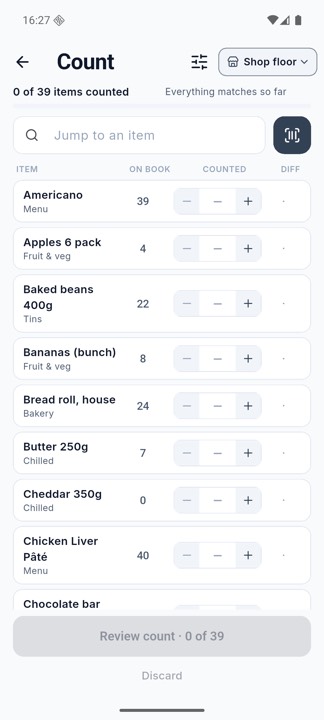
- One place at a time. Stock can sit in as many places as you have, such as the shop floor, the stock room or a market stall, and a count is made for one of them.
- Scan or tap. Each scan of a barcode is one more on the pile, or you use the buttons beside each item.
- Blind counting is a setting. Turn it on and the book figures are hidden while you count, for the reason above.
- A review before anything changes. You see what is short, what is over and what was not counted, with the difference worked out at cost.
- A limit that asks first. You can set an amount above which a single difference must be approved before it is written.
- Nothing is written until you apply. Applying records one entry for each difference, so the history shows what was corrected. Items you did not count are left alone.
- A rota by category. You can set how many days between counts of each category, which is the cycle count above.
You can also run a count from a computer on the same Wi-Fi, through Desktop access, and a USB barcode scanner plugged into that computer works as a scan.
Shop Counter is free on Google Play and the App Store, at brightscalelabs.com/apps. The rest of the day on the counter, from the delivery to the cash-up, is in this earlier post, and the three ways it reads a barcode are in this one.